 |
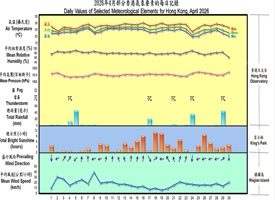 |
The Weather of April 2026 – An exceptionally warm April
The exceptionally warm weather in the first quarter of 2026 continued into April 2026, mainly attributed to the warmer-than-normal sea surface temperatures and a stronger-than-usual southerly flow in the lower atmosphere over the northern part of the South China Sea. The monthly mean minimum temperature, mean temperature and mean maximum temperature were respectively 2.7, 2.5, and 2.3 degrees above their corresponding normals, the second highest on record for April.
|
 |
New report suggests more global temperature records ahead
Global average temperatures are likely to continue at or near record levels in the next five years, with Arctic temperature anomalies expected to continue to be higher than the global mean, according to a new report from the WMO. Annual global mean near-surface temperatures during 2026–2030 are predicted to range between 1.3°C and 1.9°C above the 1850-1900 average. It is likely (86% chance) that one year between 2026 and 2030 will surpass 2024 as the warmest year on record.
|
 |
 |
ENSO: Recent Evolution, Current Status and Predictions
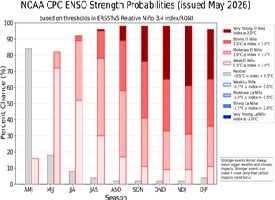
According to Climate Prediction Center / NCEP’s update, El Niño is likely to emerge soon (82% chance in May-July 2026) and continue through Northern Hemisphere winter 2026-27 (96% chance in December 2026 – February 2027). In November 2026- January 2027, there are nearly 1-in-3 chances of a strong and very strong El Niño (combined 2-in-3 chance). There is a 1-in-3 chance of RONI remaining weaker than strong El Niño.
|
|
 |
What previous Super El Niños can tell us about the next one
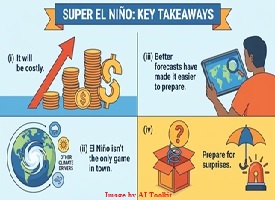
The coming “Super” El Niño is poised to affect the lives of hundreds of millions of people worldwide as it strengthens through the year into the winter season. It may also alter ecosystems for decades to come, judging from the repercussions of past intense El Niños. Takeaways: (i) It will be costly; (ii) El Niño isn’t the only game in town; (iii) Better forecasts have made it easier to prepare and (iv) Prepare for surprises.
|
|
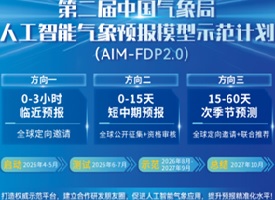 |
第二屆人工智慧氣象預報模型示範計畫發佈
示範計畫錨定氣象預報業務全鏈條,劃分為臨近、短中期、次季節三大專項示範方向,實現從短時臨近預報到次季節氣候預測的全時間尺度覆蓋。臨近預報重點突破對流風暴快速生消演變的業務瓶頸,短中期預報全面檢驗模型確定性預報與概率化集合預報能力,次季節預測重點推動構建開放共用的人工智慧氣候預測多模型集合平台,破解氣候預測中單一模型信號不穩的行業難題。
|
|
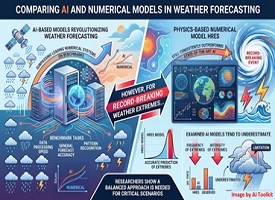 |
Physics-based models outperform AI weather forecasts of record-breaking extremes
AI–based models are revolutionizing weather forecasting and have surpassed leading numerical weather prediction systems on various benchmark tasks. However, researchers show that for record-breaking weather extremes, the physics-based numerical model HRES still consistently outperforms state-of-the-art AI models. The examined AI models tend to underestimate both the frequency and intensity of record-breaking events.
|
|
 |
Latest trends in Greenhouse Gases
The graphs show monthly mean carbon dioxide globally averaged over marine surface sites. The Global Monitoring Laboratory has measured carbon dioxide and other gases (CH4, N2O, SF6) for several decades at a globally distributed network of air sampling sites [Conway, 1994]. The last year of data are still preliminary, pending recalibrations of reference gases and other quality control checks.
|
|
 |
Membership renewal is now more convenient
Payment through Faster Payment System (FPS) is now available (Our FPS ID: 166920512). Support your society, don’t forget to renew your membership!
|
|
通訊錄的文章只以文章原本的語言表達。
The news in the Newsletter will be presented in the originating language only. |