 |
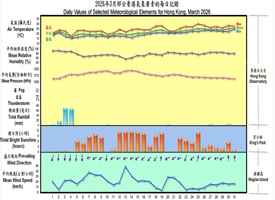 |
The weather of March 2026 – an unseasonably warm and rainy March
The weather for March 2026 was much warmer than usual in Hong Kong. The monthly total sunshine duration amounted to 165.0 hours, 65 percent above the normal of 100.0 hours. With more sunshine, the monthly mean temperature of 21.5 degrees, monthly mean maximum temperature of 24.5 degrees and monthly mean minimum temperature of 19.6 degrees were 2.0 degrees, 2.6 degrees and 2.0 degrees above their corresponding normals.
|
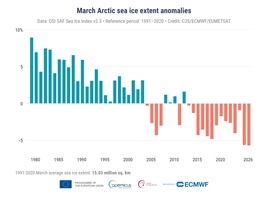 |
Sea surface temperatures approach record levels in March
“Copernicus data for March 2026 tells a sobering story: 1.48°C above pre-industrial levels, the lowest Arctic sea ice extent on record for March, and sea surface temperatures again approaching historic highs. Each figure is striking on its own — together, they paint a picture of a climate system under sustained and accelerating pressure.” said Carlo, Buontempo, Director Copernicus Climate Change Service at ECMWF.
|
 |
 |
Global Seasonal Climate Update for May-June-July 2026
For May–July (MJJ) 2026, the Niño 3.4 plume indicates a rapid warming trend. Following the transition to neutral conditions in early 2026, the multi-model ensemble (MME) shows a nearly unanimous trajectory toward El Niño by May. By MJJ, the MME average approaches 1.5°C. The tight clustering of the models, despite the typical spring predictability barrier, underscores the high confidence in the onset of El Niño, followed by further intensification.
|
|
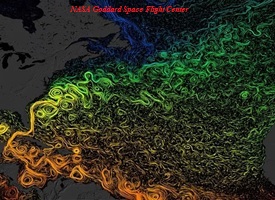 |
A vital system of Atlantic Ocean currents is weakening and closer to collapse than thought, new studies find
The critical system of ocean currents which loops around the Atlantic Ocean is weakening and could be far closer to collapse than previously thought, according to two new studies — an event which would have catastrophic impacts on the planet’s weather and climate. The two new studies — one which focuses on the AMOC’s future, the other on its present — provide new and alarming evidence of its decline.
|
|
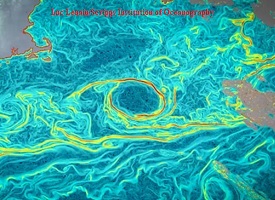 |
AI just revealed ocean currents we’ve never been able to see
A new AI-driven method called GOFLOW is turning weather satellite images into highly detailed maps of ocean currents. By tracking how temperature patterns shift over time, it can reveal fast-moving, small-scale currents that were previously impossible to observe directly. These currents are key to understanding climate, marine ecosystems, and carbon storage. The breakthrough works using satellites already in orbit, making it both powerful and cost-effective.
|
|
 |
Scientists have found an alarming environmental impact of vast data centers
The vast data centers that power artificial intelligence guzzle huge amounts of energy but they also have another alarming impact, according to new research. They are creating “heat islands,” warming the land around them by up to 16 degrees Fahrenheit. Strikingly, the impacts weren’t limited to a data center’s immediate surroundings; temperature increases affected areas up to 6.2 miles away, the research found, affecting more than 340 million people.
|
|
 |
Turning aviation research into safer skies
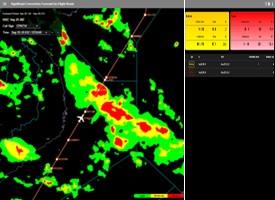
Between 2021 and 2025, the WMO addressed this challenge through the second phase of the Aviation Research and Development Project (AvRDP2), aimed to strengthen both the scientific understanding and operational use of aeronautical meteorology. AvRDP2 focused on two demanding flight corridors: Hong Kong – Singapore, where warm rising air often creates powerful tropical storms, a process known as deep convection, and London – Johannesburg, which spans midlatitude, tropical and data-sparse regions.
|
|
 |
Membership renewal is now more convenient
Payment through Faster Payment System (FPS) is now available (Our FPS ID: 166920512). Support your society, don’t forget to renew your membership!
|
|
通訊錄的文章只以文章原本的語言表達。
The news in the Newsletter will be presented in the originating language only. |